First violins5
- Tijana Milošević concertmaster
- Tara Laban
- Natalija Tatić
- Zoja Miličev
- Miljan Stanišić
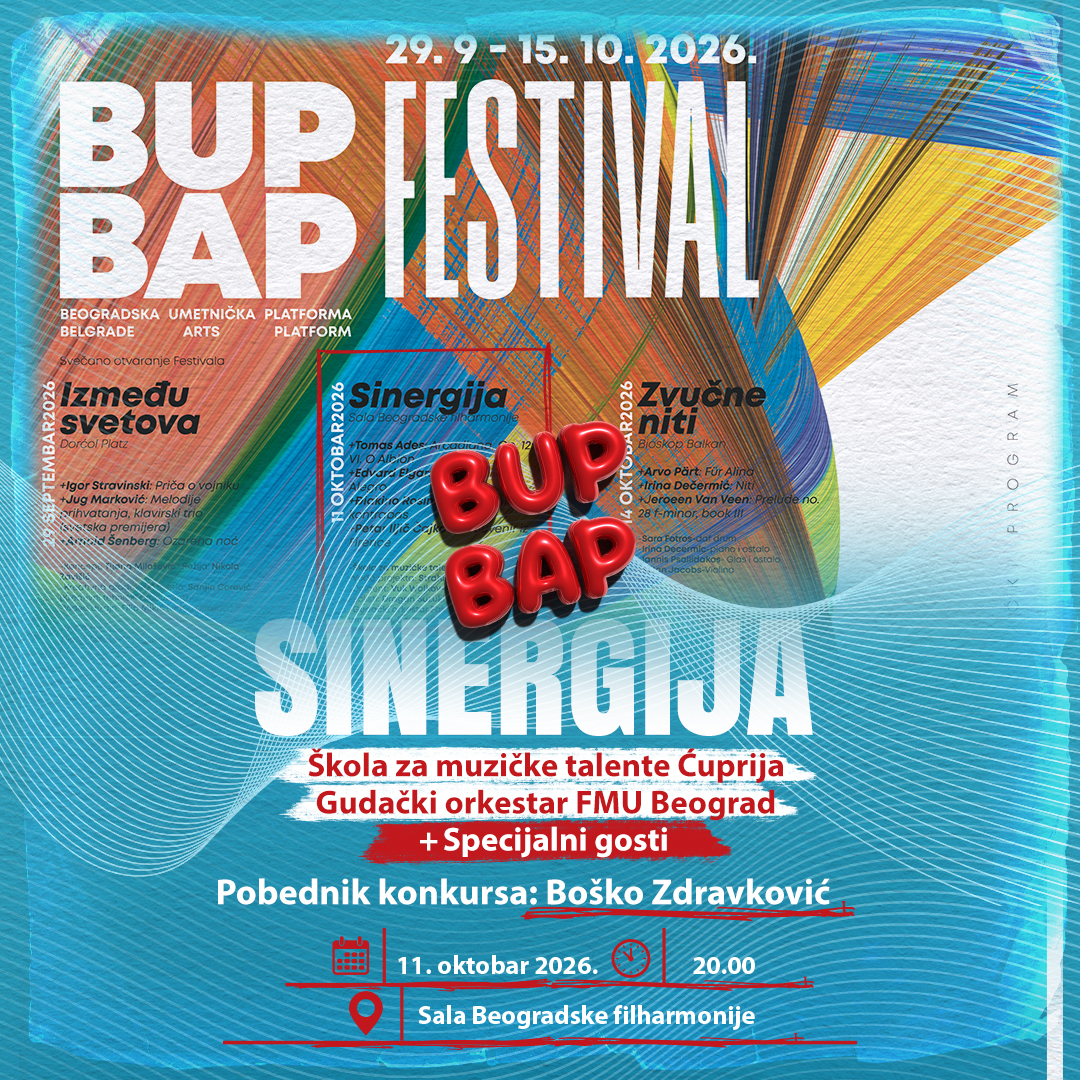
Arcadiana , Op. 12– Thomas Adès (1971–)
Arkadiana, Op. 12– Tomas Ades (1971–)
Introduction & Allegro, Op. 47 – Edward Elgar (1857–1934)
Introdukcija i Alegro, Op. 47 – Edvard Elgar (1857–1934)
Duetto per Violoncello e Contrabasso in Re maggiore – Gioachino Rossini (1792–1868)
Duet za violončelo i kontrabas u De duru – Đoakino Rosini (1792–1868)
Souvenir de Florence - Pyotr Ilyich Tchaikovsky (1840–1893)
Suvenir iz Firence, Op. 70 – Petar Ilič Čajkovski (1840–1893)
String Orchestra
About the work
Thomas Adès (1971–)
Commissioned by the Endellion String Quartet and premiered at the Cambridge Elgar Festival in 1994, Arcadiana is a work for string quartet in seven movements. Each evokes visions of “Arcadia” – a mythical, idyllic realm of natural beauty and imagination. Adès employs a rich palette of timbres and contrasts, creating music that is at once modern and deeply rooted in tradition. The sixth movement, Albion, takes its title from the oldest known name for Britain, found in Greek and Roman sources (such as Ptolemy and Pliny the Elder) and later adopted in medieval poetry with romantic, mythical associations. Meditative and hymn-like in character, the movement unfolds in slow, expansive chords, evoking a sense of suspended time. The harmonies are tonally colored, more atmospheric than cadential, with no prominent melodic line – a musical meditation. he style alludes to Baroque chorales and the English hymn tradition, yet expressed in a contemporary idiom.
About the work
Edward Elgar (1857–1934)
Introduction and Allegro (1905). Written for string quartet and string orchestra to showcase the newly founded London Symphony Orchestra, this composition blends Romantic expressiveness with Baroque form. The introduction presents a ceremonial fanfare and a nostalgic theme inspired by Welsh folk music, while the Allegro demonstrates virtuosity through fugued counterpoint and a vigorous finale. As one of Elgar’s key works for strings, it stands both as a homage to tradition and a statement of modern English musical identity.
About the work
Gioachino Rossini (1792–1868)
Duet for Cello and Double Bass in D major (1824) is one of the rare chamber works written for this unusual combination of instruments, the duet was commissioned by Rossini’s contemporary, the virtuoso double bassist Domenico Dragonetti, and amateur cellist Sir David Salomons. Structured in three movements – a lively Allegro, a lyrical Andante molto in the style of an aria, and a spirited final Allegro (zingarese) with a dance-like character – the piece infuses operatic spirit and melodic richness into the intimate dialogue of two low-register instruments, highlighting their virtuoso potential.
About the work
Pyotr Ilyich Tchaikovsky (1840–1893)
Souvenir de Florence. Composed during Tchaikovsky’s stay in Florence, this string sextet (two violins, two violas, two cellos) is the only work of its kind in his oeuvre. The title refers to a theme sketched in Florence while working on the opera The Queen of Spades. The four movements – energetic Allegro con spirito, lyrical Adagio cantabile e con moto, lively Allegretto moderato, and exuberant Allegro con brio e vivace – combine melodic richness and Romantic character with strong Russian folk elements. Premiered in St. Petersburg in 1890, the work quickly became one of the most performed chamber pieces of Russian Romanticism.
Dragan Suzuki Đorđević is one of the leading cellists of his generation, educated at the School for Musical Talents in Ćuprija and the Faculty of Music in Belgrade under Sandra Belić. He furthered his studies at the Guildhall School of Music and Drama in London with Stefan Popov, performing with the London Symphony Orchestra and serving as guest principal cellist of the Royal Northern Symphony. He continued his training in Germany with Jang-Chang Choom, earning an honorary diploma. Today he is active as professor at the Faculty of Music in Belgrade and as a performer, collaborating with distinguished artists at home and abroad.
Strahinja Mitrović is Serbian double bassist and co-founder of the Belgrade Artistic Platform. In 2024 he won the prestigious Gold Medal of the Guildhall School of Music and Drama, becoming the first double bassist in history to receive the award since the school’s founding in 1915. He is also laureate of the Prince’s Prize, Concordia Foundation Barthel Prize, Wigmore Prize, and the Musicians’ Company Silver Medal. Named among Classic FM’s “30 Under 30” Rising Stars, he has performed in leading European concert halls with renowned conductors, soloists, and chamber musicians. He completed undergraduate and postgraduate studies at Guildhall under Rinat Ibragimov, Luis Cabrera, and Louise Hopkins.
Vuk Wolkov-Popović is Serbian-Danish conductor, engaged since 2022 with the Belgrade Philharmonic in programs ranging from concerts for babies and children to major symphonic works. He assisted Gabriel Feltz in Wagner’s Tristan und Isolde and Kerem Hasan in Strauss’s Alpine Symphony. In 2026 he prepared the Philharmonic for its India tour under Zubin Mehta. Founder of the Belgrade Youth Orchestra (BEOM), he has led performances across Serbia and abroad, including at the World Festival of Youth Symphony Orchestras in Moscow. He has conducted premieres of contemporary works, collaborated with ensembles such as Metamorfozis and RTS Symphony Orchestra, and studied conducting at the Faculty of Music in Belgrade under Biljana Radovanović Brkanović, completing his master’s degree in 2025.